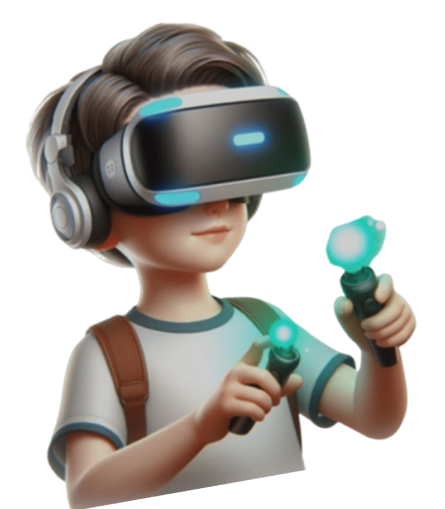
“Wowify your students with an immersive experience to different worlds at your school.”
ORBIT-VR program
CubedDigiCo Inc, provides educational institutions with the chance to immerse students in captivating virtual experiences that will truly amaze and inspire them. Imagine:
• Exploring the vastness of space and seeing the cosmos up close. • Diving deep into the ocean, swimming alongside fascinating sea creatures. • Taking a whirlwind virtual tour of iconic cities like London. • Experiencing the thrill of a snow-covered roller coaster ride. • Witnessing a satellite launch from up close, feeling the excitement of space exploration. • Journeying inside the human body to explore its complex systems
These are just a few examples of the incredible experiences Orbit VR makes possible through immersive VR technology.
"Wowify your students with an immersive experience to different worlds at your school."
Get 'Immersed' in Learning - The 'Real' Way!
Step into a new era of education with our immersive learning environments. Wondering what it is?
Immersive environments allow learners to dive into simulated experiences that feel completely real. This approach makes learning more Effective, Engaging, and Exciting by moving beyond traditional textbooks.
Utilizing this immersive experience, Vivid Learning is transforming the educational landscape. With headquarters in California, USA and R&D facilities in India, CubeDigiCo Inc, is at the forefront of EdTech innovation.
Details of VR-show:
Grade level: 3rd to 10th
Each session: 30 students
Duration: 28-30 mins
number of sessions / day: 7
set-up time: 45 mins
Seating: Cushion mats
Requirements from the
School:
A clean area to accommodate 40 students
Room should have AC
Access to 15 amps power socket
2-coordinators during show
5 Incredible Benefits Your Students Will Gain Inside the Dome
Inspiring Content
Our VR-show ignites curiosity and encourages students to think critically and creatively about the Space, Solar system, Sea, Animals, and Iconic places..etc
Happiness Guaranteed
Our VR-show gives every student full of joy and wonder. Students leave with smiles, enriched by the unforgettable experience
Immersive Experience
Students experience highly curated, grade-appropriate content that makes complex concepts easier to understand.
Scientific Acumen
Our shows stimulate a thirst for knowledge, nurturing a scientific mindset and a deeper understanding of every module.
Vivid-Knowledge
After our show, students gain a profound understanding of the universe, fostering a lifelong passion for astronomy
Imagine your students
discussing Space,
Planets, Animals, Sea,
Satellite, Wonders of
world… after the show!
1. How is the ORBIT VR Show different from traditional learning methods?
Answer: Unlike textbooks or videos, ORBIT VR offers 360° immersive experiences where students feel as if they are inside the subject of focus. This bridges classroom learning with real-world exploration, making concepts memorable and engaging.
2. What curriculum areas does the program cover?
Answer: The VR modules align with academic subjects like Science (Space, Human Body, Natural Disasters, Seasons, Marine Life), Social Studies (Seven Wonders, UK & Europe tours), and Environmental Studies (Wildlife, Safety). They complement school syllabi across Grades 3–10, in line with NEP 2020 emphasis on experiential learning.
3. How long is each session and how many students can participate?
Answer: Each session is 30 minutes. One batch typically covers 30–40 students at a time, depending on headset availability. Multiple batches can be organized to include the entire school.
4. What support do teachers need to provide during the program?
Answer: Teachers mainly help with batch coordination and student discipline. The ORBITVR team handles equipment, setup, guiding students, and sanitization. Teachers also receive a linking guide to connect VR topics with classroom lessons
5. What infrastructure is required from the school?
Answer: Schools only need to provide a classroom or auditorium space with seating and power supply. All VR equipment (headsets, sanitization kits, staff) is provided by the ORBIT VR team.
6. How safe is the use of VR headsets for children?
Answer: VR headsets are lightweight, child-friendly, and used for short intervals (10–15 minutes). Each headset is sanitized after every use. The content is age-appropriate and ensures students learn in a safe, engaging manner
7. How does the program benefit the school in the long term?
Answer: Schools position themselves as next-generation, tech-forward institutions. Benefits include:
Higher student engagement & retention
Parental appreciation for innovative learning
A unique admissions differentiator (4E approach: Experience, Exposure, Excitement, Encouragement).
8. Can the program be customized for school events or themes?
Answer: Yes. Schools can choose from a catalog of VR experiences (Space, Sea, Human Body, Wonders, Zoo, Seasons, Disasters). Special themes can be arranged for Annual Days, Science Exhibitions, or Cultural Weeks.
9. Has this program been implemented in other reputed schools?
Answer: Yes. In the first 90 days, ORBIT VR program reached 10,000 students across schools like St. Ann’s (CBSE & ICSE), Kendriya Vidyalaya-CBSE, Sun School-SSC, FortCity School-CBSE, and Bala Bhavans-SSC. and more…Many schools have given highly positive feedback.
10. Is the content only entertainment or academic as well?
Answer: It is Edutainment (Education + Entertainment). Every experience is designed to trigger curiosity, critical thinking, and scientific temperament, while still being fun and engaging.
11. How does this align with NEP 2020?
Answer: NEP 2020 emphasizes experiential, interactive learning. VR directly supports this by making science, history, and geography hands-on and immersive, ensuring higher retention and concept clarity.
(e): hello@orbitvr.in
(p): +91-9391639289
Duration : 28-30 mins
an intuitive program from USA based firm CubeDigiCo Incorporated,Dallas,TX